
Clarifying Material Grade, Condition and Documents
This guide is for engineers who write the material callout, buyers who carry it onto a purchase order and quality engineers who check what arrives.
It separates four facts that are often merged into one word: the alloy designation, its condition, the stock form and the document type. Each can then be stated, quoted and verified on its own.
Alloy, Condition and Stock Form Are Three Separate Facts
A material callout often reads like a single word, such as 6061 or 304, but it carries several requirements. The alloy designation defines a composition range. The temper or condition defines how the material has been processed, for example solution heat treated and aged, annealed or cold worked, and with it the strength, hardness and internal stress the part starts with. The stock form, whether plate, rolled bar, extrusion or forging, is usually governed by its own product specification with its own property limits.
When only the alloy is written, each supplier fills the gaps with its own default. One quote may assume stress-relieved plate, another a cheaper extrusion of the same alloy in a different condition. Both carry the same alloy name, yet they machine differently, distort differently after roughing and may not reach the strength the design assumed. Comparing those quotes on price compares two different parts.
Related: Materials and surface finishing
General example
6061-T6 and 6061-T651 share an alloy and a basic temper; the T651 suffix adds stress relief by stretching, which changes how plate behaves when deep pockets are machined.
What a Complete Material Callout States
A callout that can be quoted and checked answers the same questions every time. Put it on the drawing, and say on the purchase order whether the drawing or the order governs if the two ever disagree. Where the design allows alternatives, list them by full designation and condition instead of writing 'or equivalent', which hands the decision about equivalence to whoever reads it.
Designation and system: the alloy or grade as written in the standard you use, such as a UNS, EN or national designation, not a trade name.
Condition or temper: the supplied condition, plus the condition the finished part must be in if it changes during manufacture.
Product form and specification: plate, bar, extrusion or forging, and the specification and revision the stock must meet.
Source restrictions: approved producers, origin requirements or compliance declarations your program requires.
Substitution rule: whether alternatives are allowed and who approves them in writing before material is cut.
Required documents: the certificate type and whether a copy ships with every batch.
Write it once
if the full callout lives in a drawing note, avoid restating a shortened version on the order. Two versions invite a mismatch.
How Vague Material Callouts Cause Problems
Most material disputes start with a callout that two people read differently, and the difference only appears at receiving inspection or later in service. The table pairs common gaps with what typically goes wrong and what to state instead. None of these fixes needs special knowledge from the supplier; each needs the designer's intent written down where the supplier will read it.
| Gap in the callout | What tends to go wrong | What to state instead |
|---|---|---|
| Alloy only, no condition | Stock arrives in a condition the design did not assume | The temper or condition required at delivery |
| 'Or equivalent' with no approval rule | A nominal equivalent from another standard is used with different limits | Listed alternatives, or written approval before cutting |
| No product form | Extrusion used instead of plate, or bar instead of forging | The form and the specification it must meet |
| Specification without revision | Stock is certified to an older edition with different limits | The specification revision, or the edition current at order date |
| Heat treatment implied by a note | Unclear who treats the parts and which condition is inspected | Treatment, stage, responsibility and acceptance check |
| Documents not named | A declaration arrives where a test certificate was expected | Certificate type and copies required per batch |
When the Condition Changes During Manufacture
Some parts do not stay in their supplied condition. A steel part may be machined in a softer state and hardened afterward, an aluminum part may be stress relieved between roughing and finishing, and welding or brazing changes the condition locally. In each case the mill certificate still describes the stock as the producer delivered it. It says nothing about the condition of the finished part.
The drawing then needs to state the condition at delivery and, where relevant, the stage at which dimensions apply, because heat treatment can move features. Agree who performs the treatment, which specification it follows, what record it produces and how the result is checked, for example by a hardness test on a defined surface or a test piece processed with the batch. That record is separate from the material certificate and should carry the same batch reference.
Ask directly
if a supplier proposes pre-hardened or pre-treated stock instead of treating after machining, handle it as a change to the material requirement and approve it explicitly.
How a Material Record Follows Stock to the Finished Part
A certificate proves something about one heat or lot of material.
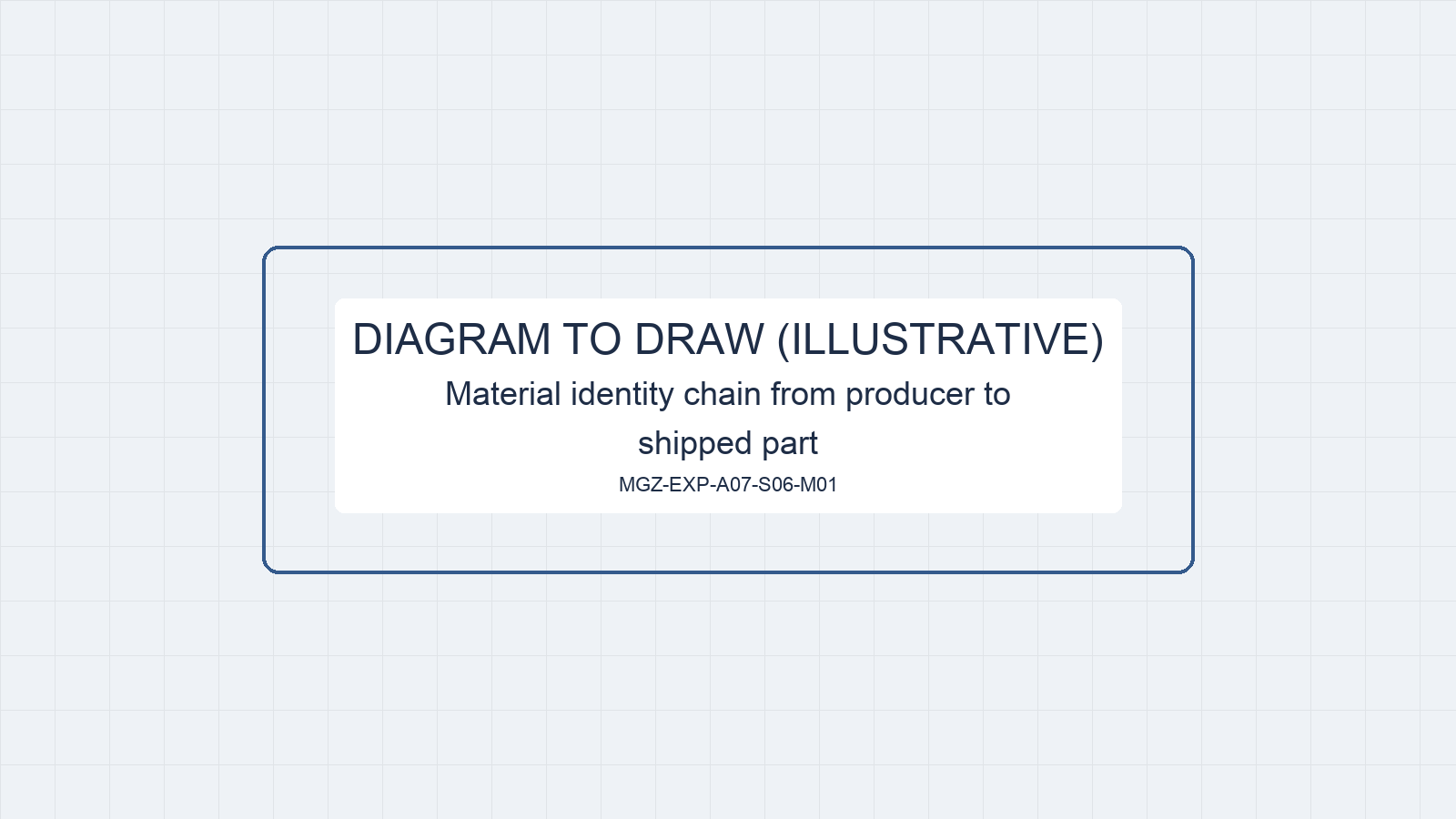
Each transfer of stock is a point where heat or lot identity must be carried forward — concept illustration
Linking it to your parts depends on an unbroken chain of identification: from the producer, often through a distributor who cuts and repacks stock, to the blanks sawn at the machine shop and the finished parts in the shipment. Every transfer is a point where that identity can be lost.
Ask how the heat or lot number is carried when bar is cut into blanks and when offcuts go back to stock, whether one batch of parts can contain material from more than one heat, and how the certificate copy is matched to the shipment. If a distributor issues its own certificate, check that it carries the producer's heat number and does not replace the original test data with a summary.
- 01Producer
melts, processes and tests a heat, then issues the certificate.
- 02Distributor
cuts and ships stock while keeping the heat marking and certificate.
- 03Incoming check
the marking on the stock is compared with the certificate.
- 04Cutting and machining
blanks and parts carry the heat or lot reference.
- 05Shipment
the certificate copy references the part number, revision and batch.
Reading a Mill Certificate and EN 10204 Document Types
Many material documents state their type using the European standard EN 10204, which classifies inspection documents by what was tested and who validated the result.
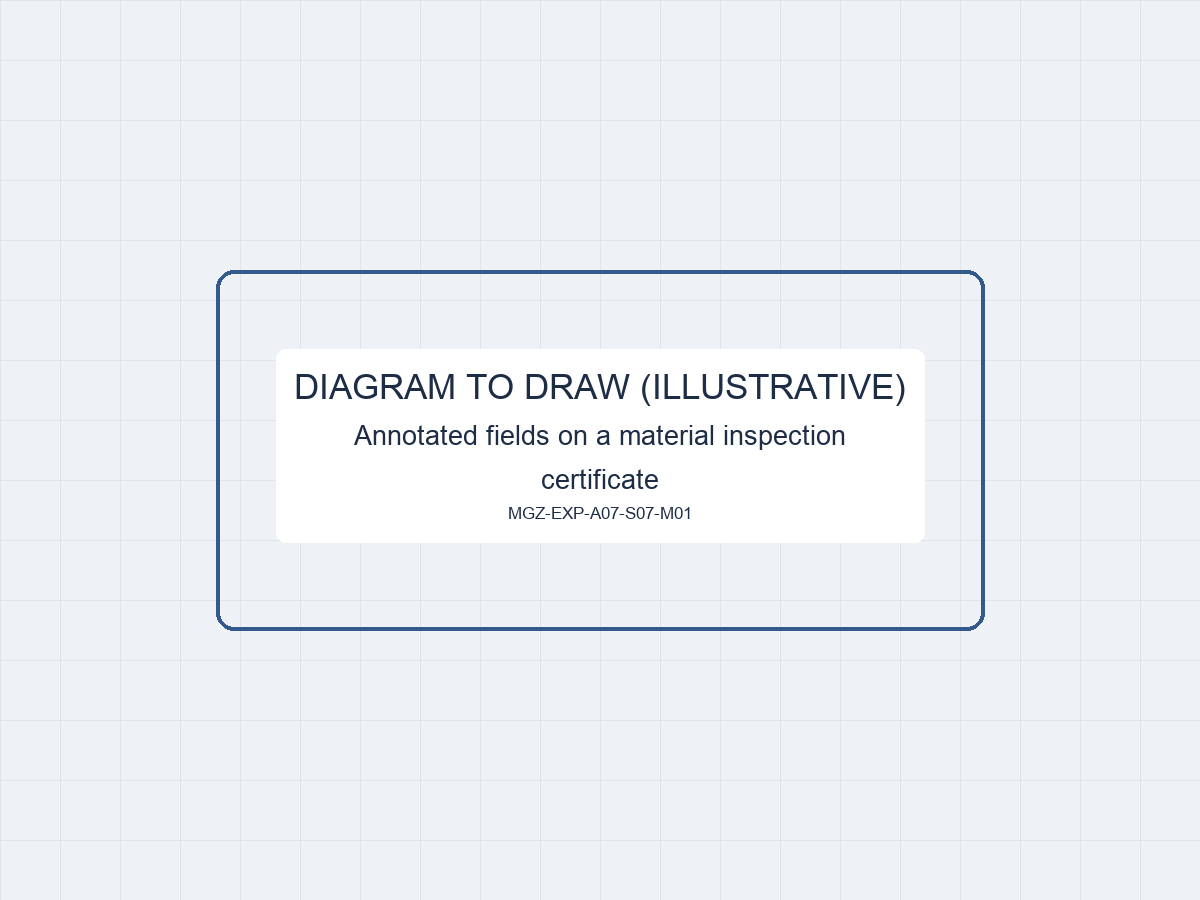
The fields a receiving inspector compares with the order and the stock marking — concept illustration
Type 2.1 is a declaration of compliance with the order, without test results. Type 2.2 is a test report based on non-specific inspection, meaning results from production of the same kind rather than the delivered product. Type 3.1 is an inspection certificate on the delivered product, validated by the manufacturer's inspection representative, independent of production. Type 3.2 adds validation by the purchaser's representative or a designated inspector.
The type tells you who stands behind the numbers, not whether the numbers meet your requirement. Comparing them with the specification limits is still the reader's job. Even a certificate that passes every check below covers only the material as the producer delivered it, not the machining, treatment or finish that followed.
Related: What to look for in an inspection report · Quality and inspection
matches the marking on the stock and the reference carried on the parts.
the one your callout names, not a similar one.
the temper, form and size range that were ordered.
chemistry and mechanical values inside the specification limits, with units stated.
who issued the document and, for a type 3.1 certificate, who validated it.
Distributor copies
a re-typed certificate is not the producer's document. Ask for the original or a copy that shows the producer and the heat number.
Requesting Documents and Comparing Supplier Answers
Name the documents on the RFQ and the purchase order, not only on the drawing, because the order is what the supplier's shipping team reads. Say whether a certificate copy must travel with every batch, be sent electronically before dispatch or be retained and available on request. Left unstated, the answer tends to be whichever is easiest for the supplier.
Supplier answers differ in how checkable they are. 'Material per drawing, certificate available' commits to very little. A useful answer names the designation, condition and form being purchased, the certificate type expected from the stock source, how heat identity is kept through cutting and machining, and whether a redacted sample document can be shared before the order. A proposed alternative material should arrive as a separate, clearly marked option for your engineers to approve or reject.
Before the first order
a redacted sample of the document you will receive shows its layout, language and fields more clearly than any description.
Related Pages
Continue with the closest related part family or guide.

Waveguide Drawing Requirements and Tolerances
Which waveguide features, datums, finish conditions and acceptance checks to define on the drawing before a machining quote.
Specifying Surface Roughness on Machined Parts
Choosing the roughness parameter, placing callouts on functional surfaces, stating the condition and checking the result on received parts.

Surface Finishing and Dimensional Requirements
How finishes change size, how to state before- or after-finish dimensions, threads and masking, and which records show the finished condition.
Material Grade and Certificate Questions
Is 6061-T6 the same requirement as 6061-T651?
Not exactly. Both describe the same alloy after solution heat treatment and artificial aging, but the T651 designation adds stress relief by controlled stretching, which applies to plate and some bar. Stress-relieved stock usually moves less when a large share of material is removed. If the design or the machining of deep pockets depends on that, write T651; if either is acceptable, say so explicitly.
Can a supplier substitute an equivalent grade from another national standard?
Only with your approval. Grades treated as equivalents often have overlapping but not identical composition limits, different property requirements or different test methods. Ask the supplier to name the proposed grade, condition and specification, compare it with your design requirement, and record the approval against the part number and revision so the next order does not silently repeat or reverse the decision.
Does a type 3.1 certificate prove my parts are made from that material?
It shows that the producer tested the delivered heat or lot and validated the results. Whether your parts came from that heat depends on how identity was carried through distribution, cutting and machining. If a batch was cut from more than one heat, expect a certificate for each heat and a record of which parts came from which.
Is a certificate of conformance enough instead of a mill certificate?
It depends on what your program requires. A certificate of conformance is the supplier's statement that the parts meet the order, and it usually carries no test results. A mill certificate carries the producer's results for the material. Some buyers need both; others accept a conformance statement for low-risk parts. Decide which applies and write it on the order.
Discuss the Material Requirement for Your Part
Send the drawing with its material callout, the condition and form you expect, and the documents your receiving team needs with each batch.

Sales contact (pending)
Name, role and photo to be confirmed
Drawings are optional for an initial discussion.
Start with the information you have; file exchange can be arranged afterward.
Name to be confirmed
Sales, company name to be confirmed
- If an alternative material is under consideration, describe it separately so it can be reviewed as an option.
Project Inquiry
Fields marked are required.